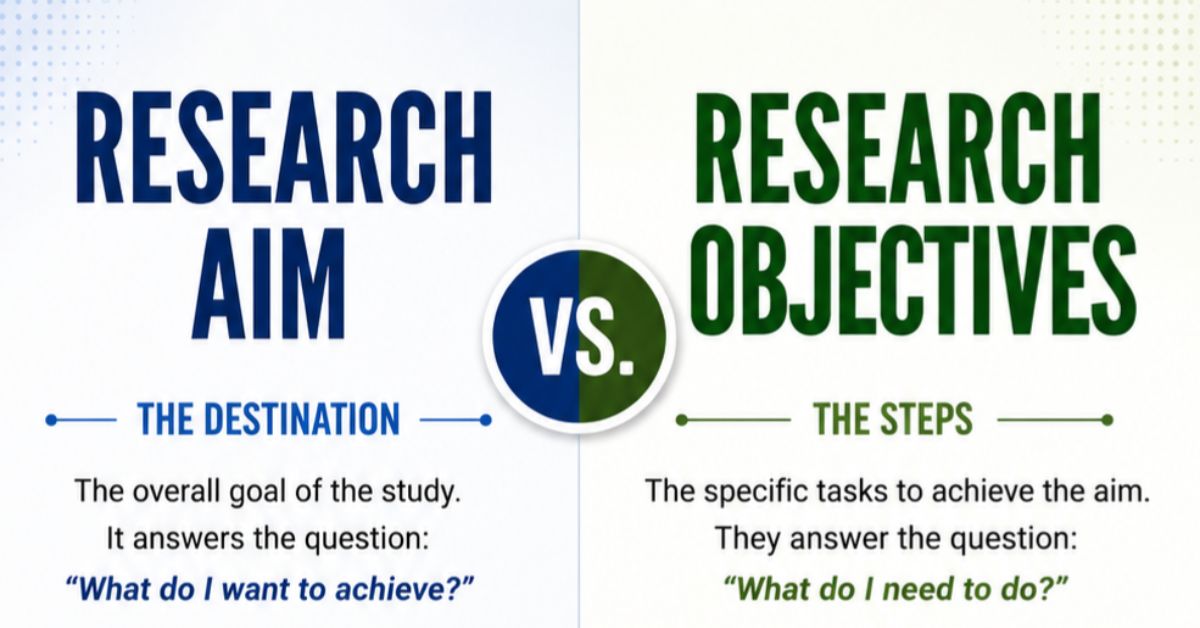
Research Aim vs Objectives: Understanding the Difference

The research aim and research objectives are closely connected, but they are not the same. Understanding the difference helps you structure your study clearly and ensures that every part of your research works toward the same purpose.

The research aim and research objectives are closely connected, but they are not the same. Understanding the difference helps you structure your study clearly and ensures that every part of your research works toward the same purpose.

What Is a Research Aim?

The research aim gives the overall purpose of your study. It describes, in broad terms, what the research intends to achieve.

Example:

To examine the influence of social media use on the academic performance of university students.

What Are Research Objectives?

Research objectives break the main aim into specific steps that your study will take to achieve it. They are more detailed and usually begin with action words such as examine, assess, determine, analyse, or evaluate.

Examples:

To determine the frequency of social media use among university students.

To assess students’ academic performance.

To examine the relationship between social media use and academic performance.

The Key Difference

  • Research Aim → Where your study is going.
  • Research Objectives → The specific steps you will take to get there.
  • The aim gives your research its destination, while the objectives provide the route.

A strong research study should have one clear overall aim supported by specific, achievable objectives.


Share:

More Posts:

research objectives and questions examples by academic field

Research Objectives and Questions: 4 Proven Examples

Research objectives and research questions work together to give a study a clear direction. Your objectives explain what the study intends to achieve, while your research questions identify what the study needs to answer.

Below are examples from different academic fields to show how objectives and questions can be developed from the same research topic.

how research questions guide your entire study

How Research Questions Guide Your Entire Study: 5 Proven Ways

How research questions guide your entire study is easy to underestimate if you only think of them as an introduction-chapter formality. They’re a roadmap for your entire study, deciding what you investigate, what information you collect, and how you analyse your findings.

common mistakes when writing research objectives

Common Mistakes When Writing Research Objectives: 5 to Avoid

Common mistakes when writing research objectives tend to repeat across theses and proposals, largely because objectives look simple to write and rarely are. Poorly written objectives can make the entire research process difficult to manage. Objectives that are too broad, unclear, or unrelated to the research problem may affect your research questions, methodology, data collection, and analysis. Most of these mistakes trace back to the same handful of habits, which is why they’re worth working through in order rather than fixing at random.

How to Formulate Research Questions

Research questions are the questions your study seeks to answer. They are developed from the research problem and help determine what information you need to collect and analyse. Well-formulated questions keep your study focused and prevent you from collecting unnecessary information.

Send Us A Message