insights

research objectives and questions examples by academic field

Research Objectives and Questions: 4 Proven Examples

Research objectives and research questions work together to give a study a clear direction. Your objectives explain what the study intends to achieve, while your research questions identify what the study needs to answer.

Below are examples from different academic fields to show how objectives and questions can be developed from the same research topic.


how research questions guide your entire study

How Research Questions Guide Your Entire Study: 5 Proven Ways

How research questions guide your entire study is easy to underestimate if you only think of them as an introduction-chapter formality. They’re a roadmap for your entire study, deciding what you investigate, what information you collect, and how you analyse your findings.

common mistakes when writing research objectives

Common Mistakes When Writing Research Objectives: 5 to Avoid

Common mistakes when writing research objectives tend to repeat across theses and proposals, largely because objectives look simple to write and rarely are. Poorly written objectives can make the entire research process difficult to manage. Objectives that are too broad, unclear, or unrelated to the research problem may affect your research questions, methodology, data collection, and analysis. Most of these mistakes trace back to the same handful of habits, which is why they’re worth working through in order rather than fixing at random.

How to Formulate Research Questions

Research questions are the questions your study seeks to answer. They are developed from the research problem and help determine what information you need to collect and analyse. Well-formulated questions keep your study focused and prevent you from collecting unnecessary information.

How to Write Clear Research Objectives

Research objectives explain exactly what your study intends to achieve. Clear objectives help keep your research focused and make it easier to determine what data you need to collect and analyse. Key Features of Good Research Objectives Specific – Clearly state what you want to investigate. Measurable – Make sure the objective can be assessed using research evidence. Achievable – Keep it realistic within your available time and resources. Relevant – Ensure it directly relates to your research problem. Time-bound – Consider the timeframe of your study. Useful Tip Start objectives with clear action verbs such as to examine, to

Frequently Asked Questions About Problem Statements

Writing a problem statement is one of the most challenging parts of a thesis or research proposal. Many students are unsure where to place it, how long it should be or what information it should include. Below are answers to some of the most frequently asked questions about problem statements.

examples of strong problem statements

Examples of Strong Problem Statements: 3 Proven Samples

Social media marketing has become an important strategy for businesses seeking to attract and retain customers. Despite increased investment in digital marketing, many small businesses continue to experience low customer retention. Existing studies have largely focused on large organizations, leaving limited evidence on how social media marketing influences customer loyalty among small businesses. This research seeks to address this gap by examining the relationship between social media marketing and customer loyalty.

problem statement vs research problem

Problem Statement vs Research Problem: 4 Key Differences

Problem statement vs research problem is a mix-up that trips up more students than any other pair of terms in the proposal stage, mostly because the two sound interchangeable and rarely are. Many students use the terms research problem and problem statement interchangeably. Although they are closely related, they are not the same. Understanding the difference between the two is essential because each plays a unique role in developing a strong research proposal or thesis.

how to identify a research problem

How to Identify a Research Problem: 4 Proven Sources

Every successful research study begins with identifying a clear research problem. Before you can develop research objectives, questions or hypotheses, you must first understand the specific issue your study aims to investigate. A well-defined research problem provides direction for your thesis and ensures that your study contributes meaningful knowledge to your field.

common mistakes in writing a problem statement

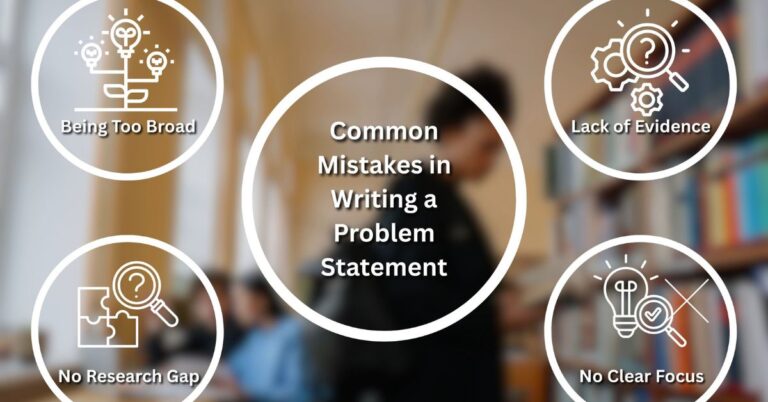
Common Mistakes in Writing a Problem Statement: 8 to Avoid

Common mistakes in writing a problem statement tend to show up in the same handful of places, which makes them easy to check for once you know what to look for. A problem statement is one of the most important sections of a thesis or research proposal. It explains the issue your study intends to investigate and justifies why the research is necessary. A well-written problem statement provides direction for your research and helps readers understand the significance of your study. However, many students make mistakes at this stage, resulting in unclear research objectives and weak proposals. Understanding these common

Order Dissertation or Assignment Help Now

Join hundreds of students who have ordered from us!